Wednesday, June 30, 2010

World Pastry Forum Day 1: Nuts

This next section was the most mundane and yet the most memorable for me - we candied nuts. But we didn't just candy them, we turned many of them into pralines and marzipan.

Almond Praliné
560 g Almond with skins
240 g Almond without skins
850 g Granulated Sugar
260 g Water
1 Vanilla bean

Hazelnut Praliné
800 g Hazelnut with skin
675 g Granulated sugar
195 g Water
1 Vanilla bean

Both follow the same process. Boil sugar and water to 118ºC. Pour over the nuts and return to a flame. The mixture will sizzle and the sugar will crystallize.

Then we toss and fold over the heat.

And toss and fold...

and toss and fold til you feel like your arms are going to fall off. Once the sugar remelts and caramelizes then be sure the sides of the bowl are scraped down to get all of the sugar crystals melted. When the nuts have a good color and great smell, pour the mixture on a silpat to cool. Cut one nut in half to make sure that it is toasted all the way through - if not there will be moisture and textural problems later.

Above is the almond that became praliné and below is the soon to be marzipan whose recipe is below.

Marzipan
525 g Almond without skins
75 g Granulated sugar
475 g Cane sugar cubes
150 g Water
90 g Glucose DE38
Almond Essence

Process the almonds and granulated sugar. Place cubes, water and glucose in a pot and cook to 116ºC. Add the almond mix to the sugar mix and combine quickly before it crystallizes. Spread the mix on a silpat and rest to cool. The nuts will crystallize and crumble.

Pop them in a food processor and grind them as well as you can.
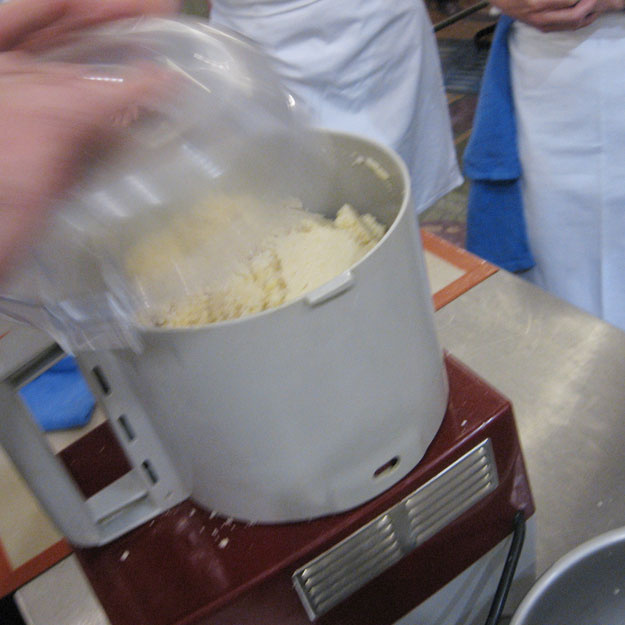
Then pull out your $8000 dual granite wheel praliné processor and go at it for about 45 minutes.

But the work is worth it. Each time you run the the nuts through the wheels you tighten the wheels another notch. Ultimately the friction from the wheels presses the oil and makes the nuts into a smooth, moist paste. Here's the hazelnut.

And here's our marzipan.

The final step is to put this back into the processor and go until its liquidy like peanut butter.

You'll note that we used a copper bowl which distributes the heat more evenly.

World Pastry Forum Day 1: Liquid Center Bon Bons

The next five days I'll be slamming the blog with posts mostly to record my memory before its lost. We're covering so many recipes and techniques, and so many off-handed tips are being thrown out that I won't remember many, but these posts will try to capture and share what I'm learning.

My instructor today was Jean-Marie Auboine who just recently took over the pastry lead at the Bellagio. A very down-to-earth chef who clearly has a mastery of confections but also instruction.

Today we did a ton of prep that will show fruits tomorrow, but here it is:

While we were all setting up our mis-en-place Chef was preparing frames full of cornstarch. He started by whisking the starch to remove lumps and fluff it up a bit.

Then he scraped it down to make it a smooth surface.

And then imprinted it with the size cavities that we would be filling. Previously Chef had covered the tables with cling wrap to make clean-up easier.

Here's how the box looked before filling...don't sneeze!

I had first seen this technique in Torreblanca 2 where he used it to create bb sized liquid balls as garnish.

Cognac or Raspberry Liquor Candies
500 g Sugar - chef only uses cube because he says they have less impurities than granular
170 g Mineral water - again for impurities
200 g Cognac or Raspberry liquor (all liquor must be 40% minimum alcohol)

Cook sugar and water to 120ºC. Add cognac warmed to 50ºC and pour back and forth between two bowls - do not whisk or stir - this prevents crystallization. Cover with a west towel and rest 5 minutes. Fill starch mold three quarters of the way- make sure portioner/pourer is warmed to 50ºC.

Above are the raspberry liquors and below are the cognac. One filling technique that Chef demonstrated is to run the portioner non-stop and the starch will roll the liquid forward with the momentum and allow for much faster filling and less risk of crystallization.

Sprinkle starch on top of liquids and rest three hours (less for smaller molds).

That's part one...next up is ganaches and starting our bon bons.

My Getaway Reading List

Rarely a week goes by when someone doesn't bring me a book or article to read and with my time so short, they just stack up until that special moment comes. And now I've got three weeks to get caught up!

Some of you will recognize the Big Fat Duck Cookbook in there and I see José Andres peeking out from below this Garrett Oliver Dude. Below them are:
A re-read of Blumenthal's In Search of Total Perfection
Flower Confidential - a behind the scenes look at the flower industry
Coming Home to Eat - politics of local foods
Food of the Americas
Hermé's Macaron
My Search for the Seven Molés
Two back issues of the Art of Eating - still my favorite magazine/journal
Preserving
Greweling's Chocolates and Confections
Pintxos - tapas
Cooking with Prickly Pears
and a slew of articles from New York and New Yorker magazines
oh yeah, and a recent review our our dinners HERE.

Monday, June 28, 2010

World Pastry Championship

If anyone wants tickets to the championship, gala dinner or awards ceremony, I won't be able to use mine. I will be attending the forum and the first day of the competition, but can't stay for the final day's events. Let me know if you would like them.

Wednesday, June 23, 2010

Book Review: Rasoi: New Indian Kitchen

[Note: As you've noticed, I've been incredibly busy with our dinners. That's good news of course. The down side is that I've had less time to play and find interesting things to post here. Next week I'm off for the Pastry Forum Workshop on Competition Pastries so that should provide good fodder with Stephane Treand as the instructor. In the meantime, here's a new book that I highly recommend.]

For those readers old enough to remember when parental warnings were placed on certain music, you might remember how that music became the ‘must have’ CDs and records for your collection. Vineet Bhatia opens his recently released Rasoi: New Indian Kitchen with “This book is probably not for the novice cook.” Such sweet warnings are rarely uttered in culinary books.
Read the rest of the review at The Gastronomer's Bookshelf.

Tuesday, June 15, 2010

A few more recent dishes

I'm wrapping up my current menu with only two more weeks, then all of the current dishes will go away. I love the evolution of dishes over time - Csíkszentmihályi's flow - where my confidence and abilities align to create the dish that was created in my mind long ago. Here are a few to retire...

Gazpacho. Served in a double wall sake glass with Idiazabal cheese, sunflower sprout holding Balinese pyramid salt, rose petals from our garden, bottarga and arbequina olive oil.

Cayenned cucumber sorbet. Cucumber noodle. Red cabbage sprout. Spicy white chocolate.
Recipe added for Sharlene: 2 C cucumber juice, 1/4 C agave nectar (honey or corn syrup), juice of one lemon, a pinch of salt, pinch of cayenne. Blend, strain, freeze. How's that for simple.

Crispy cheese ball. Garlic khadichi rice. Red cabbage sprouts. Mozzarella. Spicy chili garlic sauce.

Asparagus Forest. At the restaurant staff is instructed to say, "Too many ingredients to describe." Contains herb leather, saffron orange leather. Three mushroom paper. Salt cured egg yolks. Dill sauce. Mixed sprouts. Roses. Orange mousse. And a few more things depending on my mood that night.

Sunday, June 13, 2010

Bison Tongue Pain Perdu (ala Keller)

Riffing off of Keller's Under Pressure, I pickled a bison tongue about six weeks ago. I had to look at that ugly thing for six long weeks, all along hoping it was staying edible and not knowing if it would be any good at all.

After I removed it from the brine and dried the tongue I set about to clean it.

Trimmed some edges, removed the skin and membrane, cut it in half to make it easier to work with.

Then ran it through my slicer to get it as thin as I could.

Next, I took some day old brioche and lined an 8x8 pan snugly.

Soaked the brioche with a savory custard.

Added a layer of overlapping tongue slices.

More custard.

More brioche, more custard and then baked til puffed, set and brown.

Following Keller's lead I chilled the pain perdu, then used a 3" round cutter to cut crescents which were browned in a skillet with butter and held til service. At service they got 5 minutes in a 350º oven to warm. Very, very good stuff. Too bad you have to plan so far in advance.